Warehouse Automation: AGVs, AMRs, and the Future of Fulfillment Facts
Warehouse operations are becoming increasingly technology-driven as organizations look for more consistent ways to move materials, organize inventory, and support fulfillment processes. Warehouse automation combines software, robotics, sensors, material-handling equipment, and data systems to perform or assist with repetitive operational activities.
Two important technologies in this area are Automated Guided Vehicles (AGVs) and Autonomous Mobile Robots (AMRs). Although both can transport materials within warehouses and distribution environments, they use different navigation approaches and can be suited to different operational conditions. AGVs traditionally follow predefined routes or guidance systems, while AMRs generally use sensors, mapping technologies, and software to navigate changing environments.
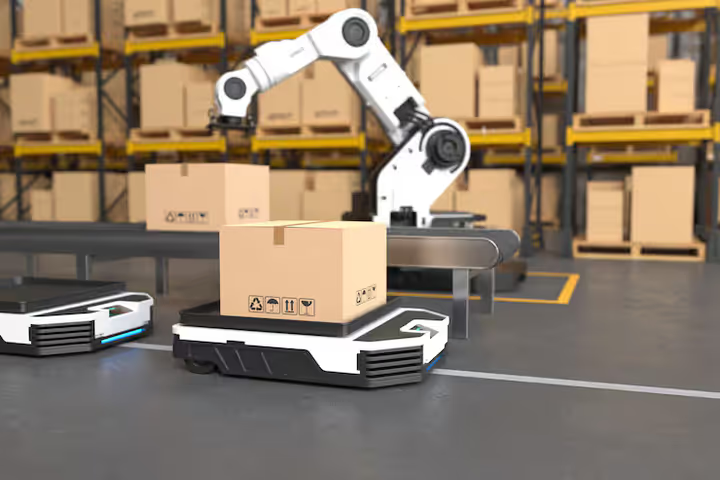
The growth of these technologies is part of a broader shift toward connected and flexible fulfillment systems. Mobile robots can work alongside other warehouse technologies, including conveyors, storage systems, barcode scanners, warehouse management software, and robotic picking equipment. Industry organizations have documented applications of AGVs and AMRs across warehousing, distribution, manufacturing, retail, and other material-handling environments.
Understanding how these technologies work, where they fit, and what limitations they have can help organizations make more informed automation decisions.
What Is Warehouse Automation?
Warehouse automation refers to the use of technology to perform, coordinate, or support warehouse activities with reduced dependence on manual movement and repetitive processes.
Automation can cover many areas, including:
- Inventory movement
- Pallet transportation
- Picking and put-away
- Sorting
- Packaging
- Storage and retrieval
- Order consolidation
- Inventory tracking
- Dock-to-storage transportation
- Data collection
Automation does not necessarily mean removing people from warehouse operations. In many modern facilities, technology is designed to assist workers by handling repetitive transportation or providing information that helps employees make operational decisions.
A warehouse automation system may combine physical equipment with software. For example, an AMR may receive a transportation task from a warehouse management system, navigate to a designated location, transport a container, and then report task completion to the software platform.
The overall objective is to create a coordinated material-flow system rather than simply introduce individual machines.
Understanding AGVs
An Automated Guided Vehicle, or AGV, is a mobile vehicle designed to transport materials automatically along predetermined or controlled routes.
Traditional AGV systems can use technologies such as magnetic guidance, wires, reflectors, markers, or other navigation methods. Modern systems may incorporate more advanced navigation capabilities, but the fundamental concept is generally based on predictable movement between defined locations.
AGVs are particularly suitable for environments where material movement follows repeatable patterns.
Typical applications include:
- Pallet transportation
- Production-line material movement
- Repetitive warehouse transfers
- Transportation between storage and production areas
- Container movement
- Long-distance internal transportation
AGVs can be useful when the warehouse layout and transportation requirements are relatively stable. MHI describes AGVs as particularly appropriate for predictable environments and repetitive point-to-point transportation tasks.
Understanding AMRs
An Autonomous Mobile Robot, or AMR, is a mobile robotic system capable of navigating its environment using sensors, software, maps, cameras, scanners, or other perception technologies.
Rather than depending entirely on a fixed route, an AMR can evaluate its surroundings and select a suitable path toward its destination. Depending on the system, it may detect obstacles and adjust its movement accordingly.
AMRs can support activities such as:
- Tote transportation
- Order-picking assistance
- Goods movement
- Workstation replenishment
- Inventory transportation
- Zone-to-zone movement
- Collaborative material handling
Their ability to operate in changing environments can make AMRs attractive for facilities where routes or workflows change frequently.
However, autonomous navigation does not mean that a warehouse can operate without planning or supervision. Effective deployment still requires appropriate facility design, safety procedures, software integration, maintenance, and worker training.
AGVs vs. AMRs: Key Differences
AGVs and AMRs can perform similar transportation tasks, but their operating approaches can differ significantly.
| Factor | AGVs | AMRs |
|---|---|---|
| Navigation | Often predefined routes | Dynamic navigation |
| Environment | Structured and predictable | More variable environments |
| Route flexibility | Generally lower | Generally higher |
| Infrastructure | May require guidance infrastructure | Often relies more on onboard sensing |
| Obstacle handling | Typically follows programmed logic | Can dynamically respond to obstacles |
| Best suited for | Repetitive transportation | Flexible material movement |
| Layout changes | May require system adjustments | Often easier to adapt |
| Software dependence | High | High |
| Human interaction | Controlled interaction zones | Designed for interaction within defined safety parameters |
| Scalability | Suitable for planned workflows | Often suitable for changing workflows |
| Navigation technology | Guidance-based systems | Mapping, sensing, and autonomous navigation |
| Common role | Point-to-point transport | Flexible transportation and workflow support |
The distinction is not absolute. Technology capabilities vary between manufacturers and system designs, so organizations should evaluate the specifications and operating requirements of each proposed solution rather than relying only on the AGV or AMR label.
How AGVs and AMRs Support Fulfillment
Fulfillment involves a series of connected activities, from receiving and storage to picking, consolidation, and dispatch.
Mobile robots can support several stages of this process.
Material transportation
Robots can move containers, pallets, totes, or other materials between designated locations. This can reduce unnecessary walking and repetitive transportation activities for warehouse personnel.
Picking assistance
Some AMR systems can bring inventory or containers to workers, creating a goods-to-person workflow. In this model, employees can remain in designated work areas while mobile robots handle transportation.
Replenishment
Automation can help move inventory from reserve storage toward picking locations based on predefined tasks generated by warehouse software.
Workflow coordination
When integrated with warehouse management or warehouse control software, mobile robots can become part of a broader workflow rather than operating as isolated machines.
Inventory movement
Automated transportation can help maintain predictable movement between storage zones, processing areas, and workstations.
The practical value depends on how well the robotic system fits the overall warehouse process. A robot introduced into an inefficient workflow may simply automate an inefficient process rather than improve it.
Benefits of Warehouse Automation
Warehouse automation can provide several potential operational advantages when appropriately designed.
Improved movement efficiency
Automated transportation can reduce the amount of time workers spend repeatedly moving materials between locations.
Greater process consistency
Software-controlled workflows can create more consistent task execution, particularly for repetitive transportation activities.
Better use of operational data
Connected automation systems can generate information about task completion, equipment activity, traffic patterns, and workflow performance.
Support for changing demand
Flexible robotic systems can potentially be adjusted as product volumes, layouts, or workflows change.
Reduced repetitive physical activity
Automation can assist with repetitive material movement, potentially allowing employees to focus on activities requiring judgment, exception handling, inspection, or supervision.
These benefits are not automatic. Results depend on facility design, workflow quality, equipment selection, maintenance, software integration, and employee training.
Challenges and Limitations
Warehouse automation also introduces challenges that organizations should evaluate before implementation.
Initial system complexity
Automation involves more than purchasing mobile equipment. A complete system may include software, charging infrastructure, sensors, communication networks, safety equipment, integration services, and maintenance processes.
Integration requirements
AGVs and AMRs may need to communicate with warehouse management systems, warehouse control systems, enterprise software, scanners, conveyors, elevators, or automated storage systems.
Poor integration can create delays and operational bottlenecks.
Facility design
A robotic system must operate within the physical characteristics of the warehouse. Floor conditions, aisle dimensions, storage arrangements, pedestrian routes, doors, ramps, and charging areas can all influence performance.
Maintenance
Robotic systems require regular inspection, software maintenance, battery management, sensor checks, and mechanical servicing.
Workforce adaptation
Employees need appropriate training to understand operating procedures, emergency processes, traffic rules, system limitations, and maintenance requirements.
Safety considerations
Automation introduces its own set of workplace risks. OSHA notes that automated equipment and robotics can create struck-by, caught-between, and other hazards when systems are not properly integrated into the workplace.
Safety Considerations for AGVs and AMRs
Safety should be considered from the planning stage rather than added after installation.
Organizations should evaluate:
- Pedestrian and robot traffic
- Emergency stopping procedures
- Robot operating zones
- Visibility and warning systems
- Charging areas
- Maintenance procedures
- Software and control-system failures
- Unexpected robot movement
- Access to restricted areas
- Worker training
- Equipment inspection
- Hazardous-energy control
OSHA identifies robotics-related risks during activities such as programming, maintenance, testing, setup, and adjustment, making non-routine activities an important part of safety planning.
Relevant safety standards and guidance can vary by application and jurisdiction. OSHA also identifies standards and consensus guidance related to industrial robots, robot-system integration, industrial mobile robots, machinery safety, and hazardous-energy control.
Organizations should therefore conduct appropriate risk assessments and follow applicable workplace safety requirements rather than assuming that autonomous navigation eliminates operational risks.
The Role of Software in Warehouse Automation
Hardware is only one part of modern warehouse automation.
Software increasingly acts as the coordination layer connecting robots with warehouse activities.
Important software components may include:
- Warehouse Management Systems
- Warehouse Control Systems
- Fleet management platforms
- Inventory management systems
- Enterprise resource planning systems
- Order management software
- Analytics platforms
- Robotics management software
A fleet management system, for example, may coordinate multiple mobile robots by assigning tasks, managing traffic, monitoring battery status, and prioritizing transportation requests.
This creates a more connected environment where automation equipment can respond to operational requirements instead of simply repeating isolated movements.
Future Trends in Warehouse Fulfillment
The future of warehouse automation is likely to involve greater integration between robotics, artificial intelligence, sensors, analytics, and warehouse software.
One important trend is the movement toward more flexible robotic systems. Earlier generations of automated vehicles often depended heavily on predefined routes, while newer autonomous systems can operate with greater flexibility. MHI's overview of AGV and AMR development describes how mobile automation has evolved from early guided systems toward increasingly sophisticated navigation technologies.
Other developments include:
Multi-robot coordination
Future facilities may use fleets containing different types of robots, each assigned to specific transportation or handling activities.
Artificial intelligence and analytics
AI-based systems can potentially help analyze traffic, demand patterns, inventory movement, and operational bottlenecks.
Greater software integration
Robotic fleets are likely to become increasingly connected with warehouse management, inventory, order processing, and enterprise systems.
Flexible warehouse layouts
As mobile robots become more adaptable, warehouse layouts may be designed around flexible transportation rather than fixed automation alone.
Human-robot collaboration
Many facilities are likely to continue using people and robots together, with workers handling decision-making, exception management, quality activities, and tasks that require adaptability.
Which Automation Approach Suits Different Situations?
Small or structured operations
Facilities with predictable transportation routes may find traditional guided automation suitable for specific repetitive workflows.
Large fulfillment environments
Large facilities with high volumes and multiple transportation requirements may benefit from a combination of AMRs, AGVs, conveyors, storage systems, and software platforms.
Frequently changing operations
AMRs can be considered when transportation routes, workstations, or workflows change regularly.
Highly repetitive processes
AGVs can be appropriate for stable point-to-point transportation where predictable routes are an important requirement.
Growing organizations
A modular automation strategy may allow organizations to introduce automation in stages and expand the system as operational requirements evolve.
The right choice ultimately depends on workflow characteristics, facility conditions, integration requirements, safety considerations, and long-term operational objectives.
Tools and Resources for Warehouse Automation Planning
Organizations researching warehouse automation can use several types of resources:
- Warehouse Management Systems — Coordinate inventory and warehouse workflows.
- Fleet Management Software — Monitor and coordinate mobile robot fleets.
- Warehouse Simulation Tools — Model traffic, capacity, and workflow scenarios.
- Inventory Analytics Platforms — Analyze movement patterns and inventory activity.
- Facility Layout Software — Evaluate warehouse layouts and material-flow paths.
- Robotics Safety Assessment Resources — Support hazard identification and risk-management planning.
- Equipment Maintenance Platforms — Track inspections, maintenance activities, and equipment performance.
Using multiple sources can provide a more complete picture than evaluating robotic equipment independently.
Frequently Asked Questions
What is the main difference between AGVs and AMRs?
AGVs generally operate using predefined routes or structured guidance systems, making them suitable for predictable transportation activities. AMRs use sensors, software, and navigation technologies to move through environments with greater flexibility. The appropriate technology depends on the facility layout, workflow requirements, safety conditions, and integration needs.
Can AGVs and AMRs work alongside employees?
Yes. Many warehouse automation systems are designed for environments where people and mobile robots operate within the same facility. However, safe interaction requires appropriate system design, traffic management, risk assessment, training, and workplace procedures. Automation should not be assumed to be safe simply because a vehicle or robot can navigate autonomously.
Are AMRs suitable for every warehouse?
No. AMRs can provide flexibility, but their suitability depends on factors such as floor conditions, traffic patterns, facility layout, inventory characteristics, software integration, and operational requirements. A detailed workflow and safety assessment should be completed before selecting an automation approach.
How does warehouse automation affect fulfillment?
Warehouse automation can support transportation, picking, replenishment, inventory movement, and workflow coordination. Its impact depends on how well the technology is integrated with existing processes. Automation can improve consistency and reduce repetitive movement, but it does not automatically resolve poorly designed workflows or inventory-management problems.
What should organizations evaluate before implementing robotics?
Organizations should evaluate workflow requirements, facility layout, safety, software integration, equipment capacity, maintenance needs, charging requirements, employee training, scalability, and system reliability. Testing a clearly defined use case before broader implementation can also help identify practical limitations.
Conclusion
Warehouse automation is evolving from isolated automated machines toward interconnected systems involving robotics, software, sensors, analytics, and human workers. AGVs and AMRs are important technologies within this transformation, but they serve somewhat different operational needs.
AGVs can be well suited to structured and repetitive transportation tasks, while AMRs can provide greater flexibility in environments where routes and workflows change. Neither technology is universally appropriate. Successful implementation depends on matching the technology to the actual warehouse process.
The future of fulfillment is likely to involve a combination of automation technologies rather than a single solution. Mobile robots may work alongside conveyors, storage systems, software platforms, and human employees to create increasingly connected warehouse environments.
For organizations evaluating automation, the most important starting point is not simply choosing between an AGV and an AMR. It is understanding the existing workflow, identifying measurable operational requirements, evaluating safety and integration needs, and selecting technology that fits those conditions. A thoughtful, phased approach can help organizations adopt automation while maintaining operational reliability, worker awareness, and long-term flexibility.